Google gives away some of the most powerful marketing tools on the internet, and most small businesses either don’t know they exist or aren’t using them properly.
The power of Google’s marketing ecosystem is that everything connects.
Your Google Analytics data feeds into your Google Ads decisions. Your Google Search Console insights inform your SEO strategy. Your Google My Business listing drives local traffic. And the Google Marketing Platform ties advertising and analytics together into a single view of your marketing efforts.
Here are the Google marketing tools you should be using in 2026, what each one does, and how to use Google’s full toolkit. As Glasgow digital marketing experts, we are here to support you in growing your business.
Google Analytics: the analytics platform every business needs
If you only set up one Google marketing tool, make it this one.
Google Analytics (now GA4) is a free analytics platform that tracks everything happening on your website. Who’s visiting, where they come from, what pages they look at, how long they stay, and whether they convert into an enquiry or a sale.
It’s the foundation of any data-driven marketing strategy, and it costs literally nothing.
GA4 is built around event-based tracking, which means it follows the full customer journey across devices and platforms rather than just counting pageviews.
It uses machine learning to surface predictive insights, like which users are most likely to purchase or which audience segments are dropping off.
Every metric that matters, from website traffic and bounce rates to conversion rates and revenue, lives in this one platform.
For any marketer running marketing campaigns, Google Analytics provides the real-time data you need to know what’s working and what isn’t. If you’re spending money on ads, publishing content, or trying to improve your SEO, this is where you go to measure business results.
Without it, you’re guessing.
Google Search Console: free SEO insight you can’t get anywhere else
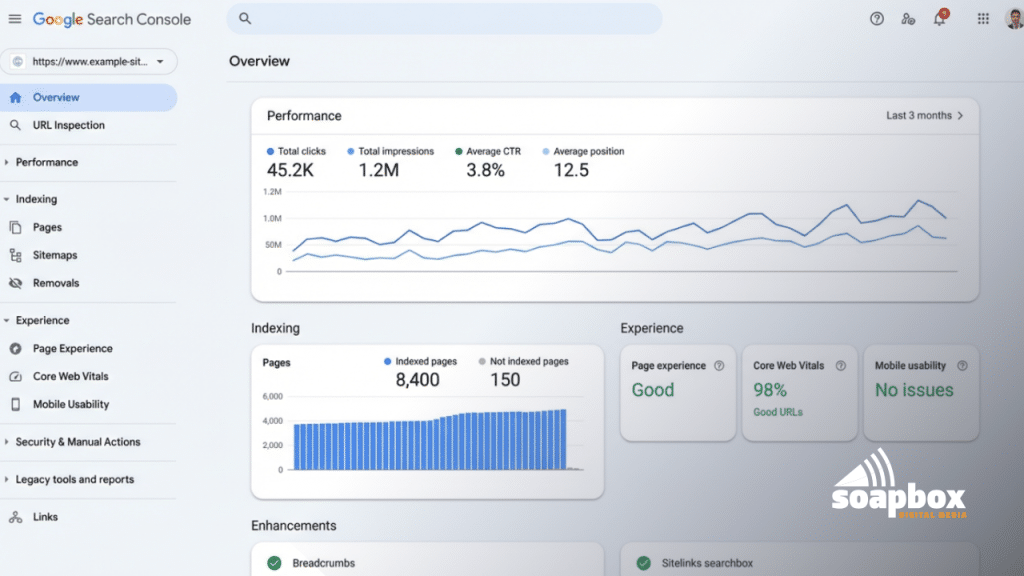
Google Search Console (formerly known as Google Webmaster Tools) is Google’s free tool for understanding how your site performs in search results.
If you want to optimise your website for search engines, Google Search Console is where you start.
It shows you which keywords or phrases people use to find your website, how often your pages appear in search, and what your click-through rates look like.
It tells you exactly which pages are performing well and which ones need work.
It will also alert you to technical issues like crawl errors, mobile usability problems, and security concerns that could be hurting your rankings.
You can use Google Search Console to submit your sitemap, request indexing for new pages, and track how Google sees your site over time.
For any business serious about SEO and growing their online presence, this is a non-negotiable tool that pairs directly with your Google Analytics data to give you a complete picture of your organic performance.
Google Ads and Keyword Planner: paid advertising and analytics combined
Google Ads is the world’s biggest advertising platform, and it’s where most businesses start when they want to appear at the top of search results immediately.
You choose keywords to target, set a budget, write your ads, and pay each time someone clicks.
The platform uses machine learning and automation to optimise your campaigns in real time, adjusting bids and targeting to maximise your ROI.
Built into Google Ads is the Keyword Planner, a great tool for discovering which relevant keywords your potential customers are actually searching for.
You can use it to research search volume, competition levels, and estimated costs per click before you spend a penny. Even if you’re not running ads, Keyword Planner is invaluable for SEO and content creation because it shows you exactly what people are typing into Google.
Google Ads supports multiple ad formats. Whether you want text ads in search results, display ads across millions of websites, shopping ads for e-commerce, and video content ads on YouTube, you have control of how you want your ad to be viewed.
And like most Google tools, the real strength is in the data.
Google Ads gives you detailed conversion tracking, so you can see exactly what happened after someone clicked, whether that was a phone call, a form submission, or a purchase.
That makes it much easier to understand what is working, what is not, and where your budget is best spent.
Google My Business: the Google marketing tool for local businesses
If you serve local customers, Google My Business (now called Google Business Profile) is one of the most important Google marketing tools you can use.
It’s free, and it controls how your business appears in Google Search and Google Maps.
When someone searches “hairdresser near me” or “cinema Glasgow,” the businesses that appear in the map pack at the top of the page are the ones with well-optimised Google My Business profiles.
Set up a Google Business Profile and fill it out completely. This includes:
- business name
- address
- phone number
- opening hours
- photos
- services
- description of what you do.
Encourage customers to leave reviews, and respond to every one. It not only helps build trust with potential customers, but it can also improve your visibility and support your rankings.
For local businesses, having a Google Business Profile is a non negotiable.
It’s free, it takes less than an hour to set up, and it puts you in front of people who are actively searching for what you offer in your area.
Google Trends: spot trending topics and seasonal demand
Google Trends uses real-time data to show you how search interest for any topic, keyword, or phrase changes over time and across regions.
It’s a brilliant tool for spotting trending topics before your competitors, understanding seasonal demand for your products, and comparing interest in different keywords to target.
It’s also useful for brand strategy.
You can track how interest in your brand compares to competitors, spot rising search terms in your industry, and identify audience insights you wouldn’t find anywhere else.
Google Trends is completely free and requires no account to use. Every digital marketer should have it bookmarked, even in 2026.
YouTube: build a channel for your business
This might be a bit cheeky, but we included it on the list!
YouTube is the second-largest search engine in the world, and it’s owned by Google.
Not using it means you’re missing a massive channel for reaching potential customers who prefer video content over text.
You can create a YouTube channel for your business for free and start publishing product demos, how-to guides, customer testimonials, and behind-the-scenes content.
You don’t need professional equipment. A phone with decent lighting and something worth saying is enough to get started.
The key is consistency, because YouTube rewards channels that publish regularly and keep viewers engaged.
For businesses, it’s one of the best ways to build trust through video content and tell your brand’s story to a wider audience.
Google Alerts: monitor your online business reputation
Google Alerts is a simple, free tool that sends you an email notification whenever Google indexes new content containing specific keywords or phrases.
Set up alerts for your business name, your key staff, your competitors, and your industry terms, and you’ll know the moment someone mentions you online.
This helps you stay on top of your reputation, with competitive analysis, and staying on top of industry news.
Looker Studio: turn your data into dashboards
Looker Studio (formerly Google Data Studio) is Google’s free data visualisation and reporting tool.
It connects directly to Google Analytics, Google Ads, Google Search Console, and hundreds of other data sources, letting you build custom dashboards that display all your marketing and analytics data in one place.
Instead of logging into five different analytics tools every morning, you can build a single dashboard that shows your website traffic, ad performance, search rankings, and conversion data side by side.
Use Google tools to help your business grow
Every one of these Google marketing tools is either free or paid only when you choose to run ads.
There’s no reason not to have them set up.
If you’re a startup with no budget, Google Analytics, Search Console, and Google My Business alone will give you more insight into your marketing than most businesses ever bother to get.
If you’ve got a budget for Google Ads, the Keyword Planner and conversion tracking will help you spend it wisely.
The world of marketing can be complex, so if you need guidance or help on how to set things up, Soapbox Digital Media is here for you. We use all these tools on the daily and can give you a run down on how to use them for marketing strategies.
For a free call or quote on how we can support you to grow your business, give our friendly team a call on 0141 429 1356 or get in touch here.