Wedding stationery confuses almost every couple planning their first wedding.
Both look similar and get sent to the same people, but they both have different purposes and are sent at different times in the wedding planning process.
At Soapbox Digital Media, we help couples and planners get their wedding stationery together for the big day.
Whether you’re designing your wedding stationery yourself or working with wedding stationery designers, here is everything you need to know about the differences between save the date cards vs wedding invitations.
What’s the difference between save-the-dates and wedding invitations? – By Glasgow printing experts
Save the date cards and wedding invitations do two different jobs at two different points in the run-up to your wedding
What is a save the date?
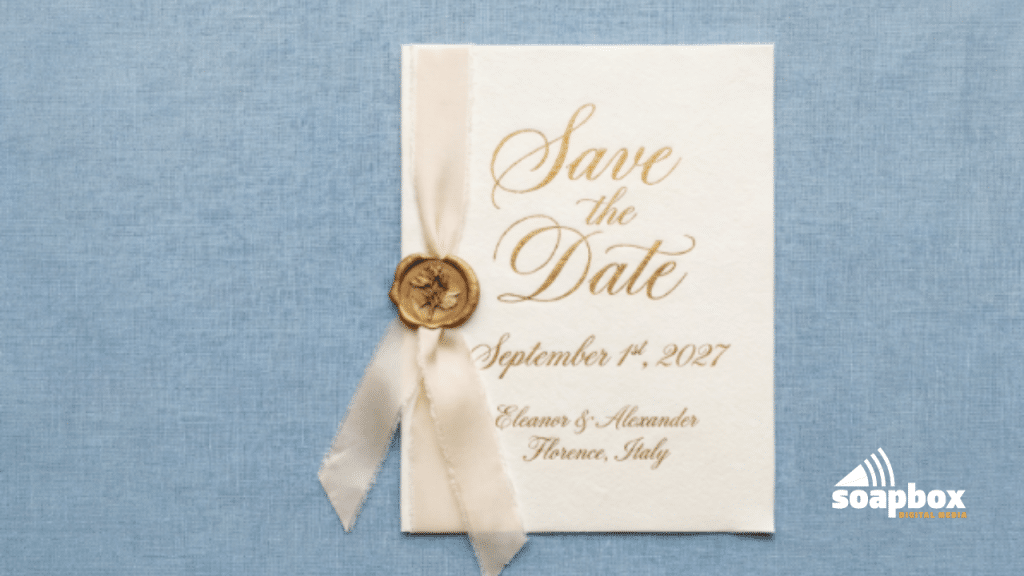
A save the date is an early heads-up. It goes out well before the wedding, tells your guests the date and roughly where it will be held, and asks them to keep it free in their calendars.
That’s it.
It doesn’t include ceremony times, dress code, RSVP details, or any of the finer details. That all comes later on in the process.
What is a wedding invitation?
The wedding invitation is the main event.
Sent closer to the date, it gives guests everything they need to confirm attendance and show up in the right place at the right time.
A full invitation suite typically includes the invitation itself, an RSVP card with a reply envelope, a details card covering travel and accommodation, and sometimes a separate reception card for evening-only guests.
When do you send each one?
Save the dates typically go out six to twelve months before the wedding, or as soon as the venue is booked, to give guests as much notice as possible.
Invitations usually come six to ten weeks before the day.
Do they need to match?
They don’t have to be identical, but keeping them within the same design family gives your stationery a cohesive feel across the whole wedding.
What about evening-only guests?
Evening guests receive an invitation only.
No save the date is needed unless the wedding is a destination event or requires significant travel planning.
What information goes on save the date cards
Save the date designs vary a lot, but the information on your save the date itself is fairly standard.
Keep it simple.
The point of a save the date is to get people to keep the date free, not to overwhelm them (or yourselves!) with wedding details you haven’t been finalised yet.
Include these things:
- The names of the couple (full names or first names, depending on how formal you want to feel).
- The wedding date (month and year if you don’t have an exact date yet; the full date if you do).
- The location at a town or city level, so guests know roughly where they’ll need to travel (you don’t need the venue locked in to send a save the date).
- A line confirming a formal invitation will be sent later, so guests know more details are coming closer to the date.
- Optionally, a link to your wedding website where you’ll add travel, accommodation, and gift list information closer to the actual wedding.
Sending digital save the dates by email is increasingly common, especially for couples trying to save money on stationery or planning a destination wedding that needs a long lead time.
Email works, though a printed save-the-date card lands better with older relatives and tends to get displayed on fridges, where people actually remember it.
What information goes on a wedding invitation?
A formal wedding invitation needs to cover everything a guest needs to turn up prepared.
Unlike a save the date, which is really just a “we’re doing this, block the diary” message, the main invitation is where the real wedding details live.
A full invitation suite usually contains:
The main invitation itself
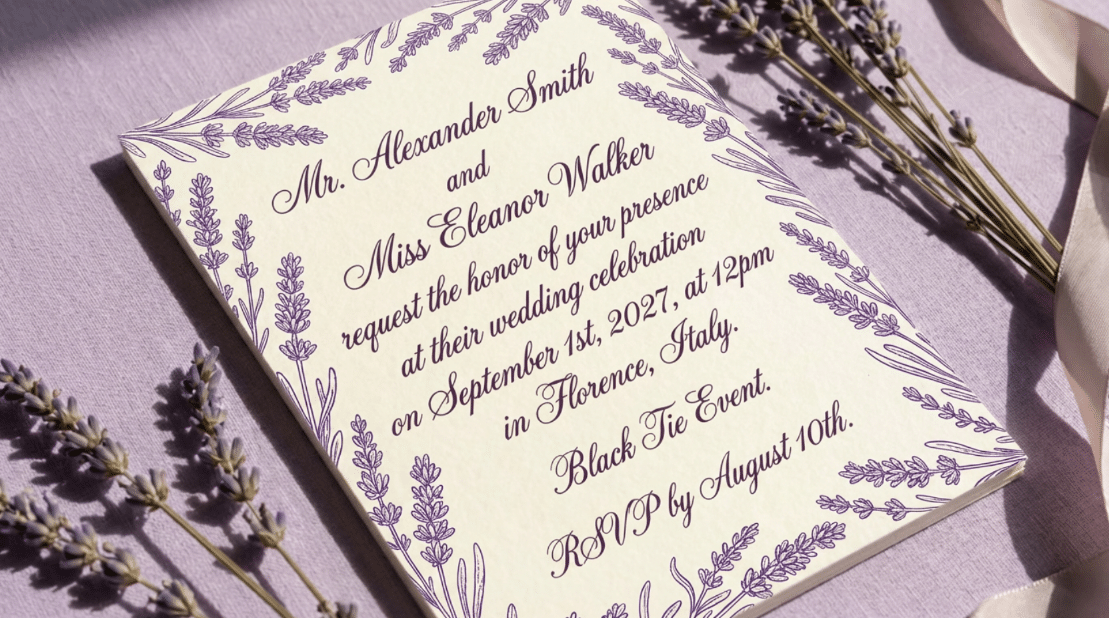
This can include full names of the couple and often the names of the parents hosting (a traditional piece of wedding invitation wording), the wedding date and location in full, the time of the wedding ceremony, the venue details, the dress code if you have one, and any reception or evening details.
An RSVP card
This section may include a physical card and reply envelope, often with a menu choice and a dietary requirements question.
That said, more couples are now turning to online RSVP tracking systems as a simpler alternative to managing physical replies.
Details card
The details card sits alongside the main invitation and covers the practical information guests need to get there.
It may include accommodation, travel, parking, and any wider weekend itinerary for destination weddings or weddings spread over multiple events.
Optional: small wedding website URL inset
This replaces the traditional details card for couples who prefer to keep logistics online.
Wedding stationery timeline
The wedding stationery timeline is what trips up most couples.
Save the dates go out earlier than people expect, and wedding invitations are sent later than people expect.
The standard UK guidance for most weddings:
Save-the-date card timeline
Save the dates are sent 6-8 months before your wedding date for a local wedding, or 9-12 months before your wedding for a destination wedding or a wedding during peak summer weekends.
Of course, if you already have your venue sorted, you should work to get the cards out as soon as possible.
The more notice your loved ones and guests have, the easier it is for them to make travel and accommodation arrangements and keep the date clear in their calendars.
When to send wedding invites
Wedding invitations should be sent 6-10 weeks before the wedding.
The rule of thumb is around eight weeks out for a UK wedding and ten to twelve weeks for a destination wedding.
Sending your wedding invitations earlier than six weeks before the wedding isn’t wrong, but it increases the risk of guests losing the details or misplacing the RSVP card, and it means invitations are sent at a later date than strictly necessary.
Later than six weeks and you’re rushing your guests’ diaries. Aim for the middle of the window if possible.
Do save the dates and wedding invitations need to match?
No, save the dates and invitations don’t need to match. Though the stronger the visual thread between the two, the more polished the overall wedding stationery feels.
Most couples we work with land somewhere in the middle.
Save the dates and wedding invitations share a colour palette, a typeface, and a general style without being identical. The save the date announces the wedding theme in a lighter form, and the main invitation fleshes it out.
Matching can feel tricky when you need to send save the dates months before you’ve finalised your wedding planning.
The wedding theme might shift, the venue might change, or your wedding stationery designers might not be chosen yet.
Plenty of couples send a simple, clean save the date card first and then design the full invitation suite later, once the wedding details are locked in.
That approach works fine. Nobody will notice if save the dates and invitations look mildly different from each other.
If you do want them to match closely, brief your designer (or yourself) on the overall style of your wedding at the start. The early save the date designs flow into the later invitation design without starting from scratch.
Save-the-dates vs wedding invitations: can you use one as the other?
No, a save the date can’t do the job of a wedding invitation.
Save-the-dates and invitations look similar but aren’t interchangeable.
A save the date doesn’t carry enough information for guests to attend the wedding, and a wedding invitation sent twelve months out doesn’t give guests enough time-relevant information to confirm anything useful.
If you’d rather not send both, skip the save the date and send the invitation only.
Just be mindful of giving guests enough notice, particularly if travel or accommodation is involved.
A word-of-mouth or virtual heads-up in the meantime can help bridge the gap and give guests a rough idea of when to expect the formal invitation.
Digital save the dates vs paper wedding invitations
Digital save the dates have taken off properly in the last five years.
Sending a save the date by email, text, or through a wedding website lowers cost, lands instantly, and works particularly well when your guest list is spread across multiple time zones.
Email save the dates are hard to ignore because they drop straight into your guest’s inbox, and the information on your save the date (names, wedding date and location, a link to your wedding website) sits at a URL your guests can bookmark rather than misplace.
Paper wedding invitations still dominate the main invitation stage, even for couples who went digital earlier.
A printed invitation feels more formal, marks the occasion physically, and gets displayed on fridges and mantelpieces in the weeks before the wedding.
Paper matters because the whole wedding stationery suite sets expectations for the style of your wedding, and a printed invitation signals “this is a real event” in a way an email rarely does.
Wedding invitations are typically A5 paper size, but we are happy to guide you through other sizes and formats should you wish. If the whole card is printed, we will also help you through crop marks and bleed marks for a beautiful finish.
A common pattern now is digital save the dates followed by printed formal wedding invitations.
That combination balances speed with formality, keeps costs sensible, and gives guests a physical artefact for the main invitation.
Should you send save the dates to evening guests?
Evening-only guests complicate the save the date question.
Some couples send save the dates to evening guests along with day guests, so everyone has the date in their calendars.
Others only send save the dates to day guests and send evening-only guests a separate invitation closer to the wedding.
Both approaches are acceptable in UK wedding etiquette, and the right answer depends on how confident you are about your evening numbers at the save the date stage.
If you send save the dates to evening guests, use a design that doesn’t imply full-day attendance. A line like “invitation will follow” keeps things open.
If you only send them to day guests, your evening guests aren’t being excluded; they’re simply getting a later invitation once the wedding day plan is fully confirmed.
Most wedding stationery designers can produce a separate, simpler invitation for evening-only guests that matches the main invitation aesthetically without being identical.
Wedding invitation wording and etiquette basics
Wedding invitation etiquette varies by tradition.
The traditional British format puts the hosting parents’ names at the top (“Mr and Mrs Smith request the pleasure of your company at the marriage of their daughter…”), followed by the couple’s names, the ceremony details, the venue, and the reception.
But modern couples has changed and often host themselves, or share the hosting across both sets of parents, and the wording adjusts accordingly.
Keep the wording clear and make sure every guest knows what they’re being invited to.
Mention the dress code if you have one, reference the wedding website URL for logistics, and make the RSVP deadline unmissable on the RSVP card.
Designing your wedding stationery with Soapbox
Get excited for you big day, with beautifully designed wedding stationary to send off to your wedding guests.
Soapbox Digital Media has produced save the dates, wedding invitations, RSVP cards, order of service cards, and full invitation suites for couples across Glasgow and the wider UK.
We can help whether you need perfect wedding stationery designed from scratch or just print-ready files produced from your own artwork.
If you’re just starting your wedding planning, or you’ve worked out the style of your wedding and need the stationery to match, give us a call on 0141 429 1356 or drop us a note through our contact page.