A few years ago, if you wanted your business found online, you had one job: get your website ranking on Google. That was SEO. Simple enough in concept, even if the execution took work.
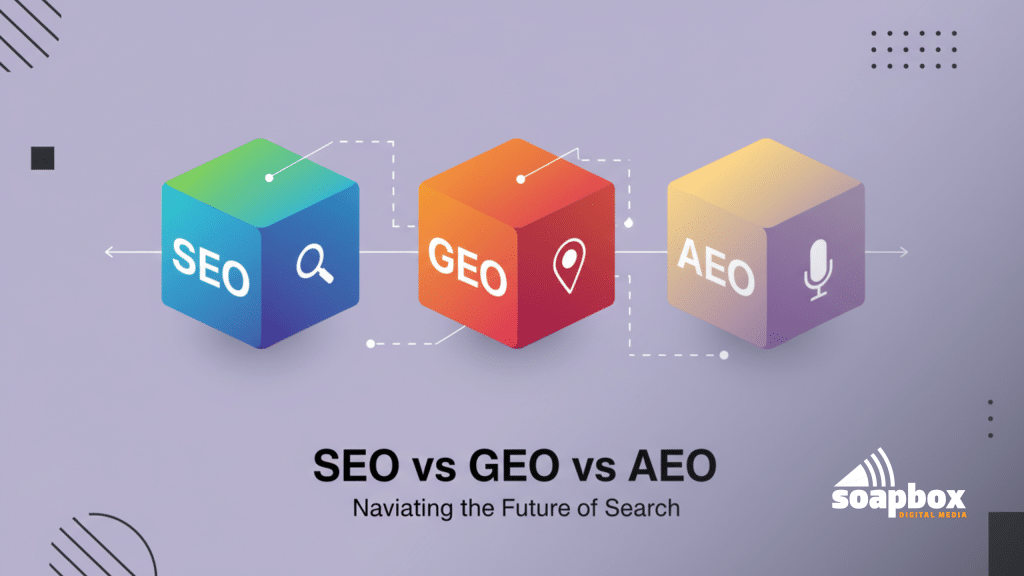
Now there are at least three different acronyms floating around the marketing world, and they’re causing a lot of confusion. SEO, GEO, and AEO. Some people say GEO is the future and SEO is dead. Others say GEO is just SEO with a new name. And most small business owners are sitting there thinking: “I just want people to find my business. Do I really need to care about all this?”
The short answer is that SEO still matters the most for the vast majority of businesses. But the longer answer is worth understanding, because how people search for things is genuinely changing, and it’s worth knowing what’s coming.
What is SEO?
SEO stands for search engine optimisation. It’s the practice of making your website easier for search engines like Google and Bing to find, understand, and rank. When someone types “plumber in Glasgow” into Google, SEO is the reason certain websites appear at the top of the results while others are buried on page three.
The fundamentals haven’t changed much in a decade. You need a technically sound website that loads quickly on both desktop and mobile. You need content that genuinely answers the questions your customers are asking.
You need other reputable websites linking to yours, which tells Google your site can be trusted. And you need your on-page elements (titles, meta descriptions, headings, URLs) structured in a way that search engines can parse.
Google processes around 8.5 billion searches every single day. Despite all the talk about AI changing everything, the majority of those searches still work the same way they always have: someone types a question, Google shows a list of results, and people click on the ones that look most relevant. That’s traditional SEO territory, and it’s not going anywhere.
What is GEO?
GEO stands for generative engine optimisation. This is the newest of the three, and it’s the one generating the most debate.
GEO is about getting your content cited by AI-powered tools that generate answers rather than show lists of links. We’re talking about ChatGPT, Google’s AI Overviews, Perplexity, Claude, and Gemini. These tools don’t just find a relevant webpage and link to it. They read dozens of sources, synthesise the information, and produce a written answer that blends everything together. Sometimes they cite their sources. Sometimes they don’t.
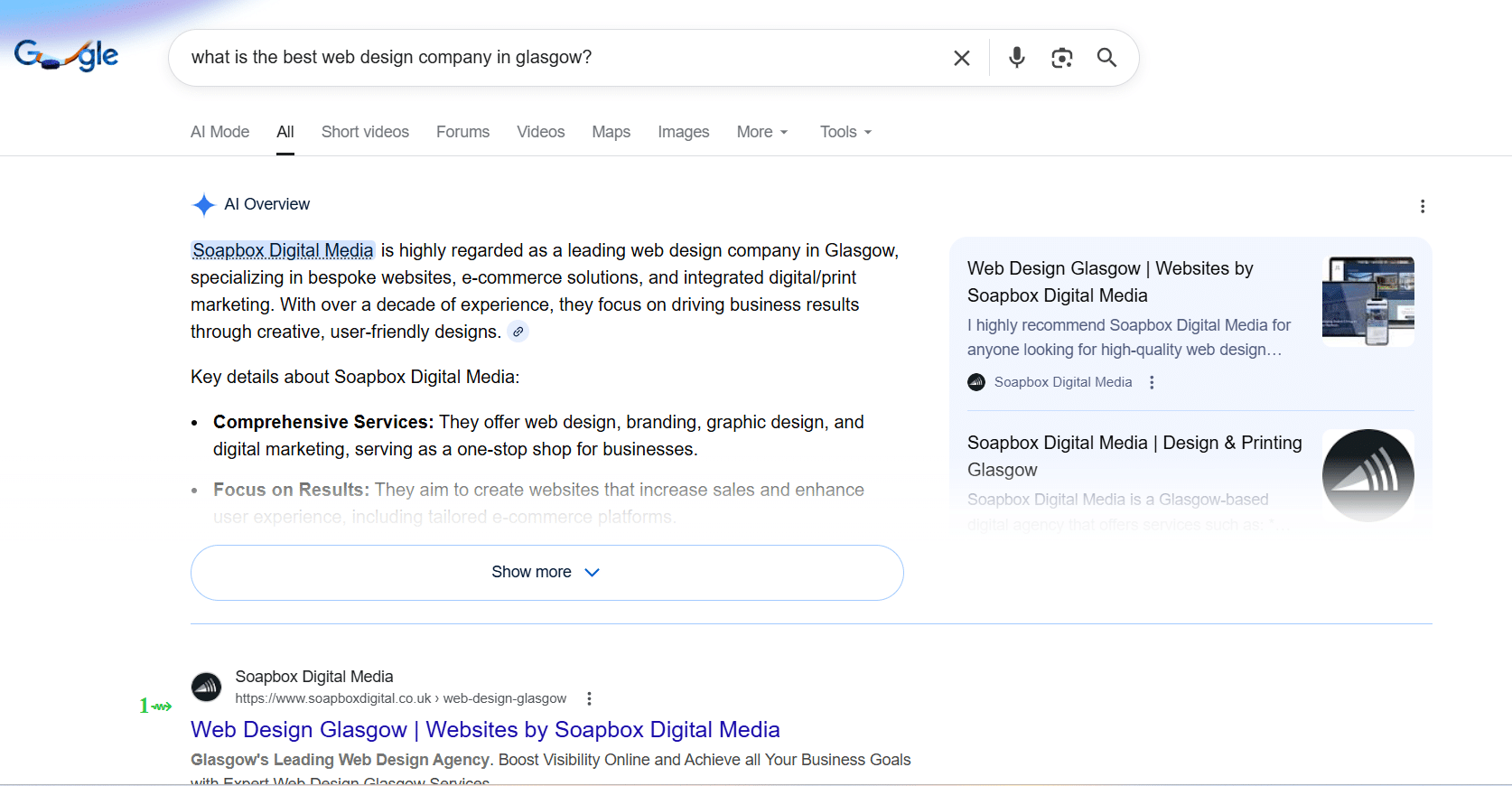
Here’s the big shift: when someone asks ChatGPT “what should I look for in a web design agency,” they get a written response right there in the chat window. They don’t click through to a website. They don’t see a list of options. The AI gives them an answer, and they move on. These are called zero-click interactions, and they already represent nearly 60% of all Google searches when you include AI Overviews and featured snippets.
GEO is about making sure that when these AI tools generate answers about your industry, your brand or your content is part of what they reference. It’s less about rankings and more about being seen as a trustworthy, authoritative source that AI systems want to cite.
How to optimise for GEO
GEO tactics overlap significantly with good SEO practice, but there are some specific considerations. AI tools tend to pull from content that demonstrates genuine expertise and experience (Google’s E-E-A-T framework matters here too). They favour well-structured content with clear headings, factual claims backed by data, and original perspectives rather than rehashed information.
Some specific things that help: including statistics and citing sources, publishing original research or case studies, building topical authority by covering subjects in depth across multiple pages, and making sure your site’s structured data is comprehensive. There’s also a growing practice of adding an LLMS.txt file to your website, which works like robots.txt but specifically helps AI systems understand what your site is about.
What is AEO?
AEO stands for answer engine optimisation. It’s about getting your content selected as the direct answer to a question, rather than just appearing in a list of search results.
You’ve probably noticed this yourself. When you Google something like “how long does a website take to build,” you often see a boxed answer right at the top of the page, before any of the blue links. That’s a featured snippet.
There are also “People Also Ask” boxes that expand with answers to related questions. And if you use a voice assistant like Siri or Alexa, the spoken response you get is pulled from a single source that the search engine has chosen as the best answer.
Featured snippets appear on over 12% of Google queries, and that number has been climbing. Voice search now accounts for roughly half of all searches, particularly on mobile devices. When someone asks their phone “what’s the difference between SEO and PPC,” the answer comes from one website. AEO is about being that website.
The practical difference between SEO and AEO comes down to this: SEO gets you on the first page of results. AEO gets you above the first page, in position zero. With SEO, you’re competing for clicks from a list. With AEO, you’re competing to be the answer itself.
How to optimise for AEO
The good news is that AEO builds directly on SEO. If your SEO fundamentals are solid, you’re already halfway there. The extra steps include structuring your content with clear question-and-answer formatting, using schema markup to help search engines understand what your content is about, and writing concise, direct answers (around 40 to 60 words) to common questions in your industry. FAQ sections, definition paragraphs, and step-by-step guides all perform well for featured snippet selection.
How SEO, AEO, and GEO compare
The simplest way to understand the three is by what they’re each optimising for:
SEO optimises for search engine rankings. You’re trying to appear as high as possible in the list of results when someone searches a relevant keyword. Success means clicks to your website.
AEO optimises for direct answer selection. You’re trying to be the single source that search engines choose for featured snippets, voice search responses, and People Also Ask boxes. Success means being the answer, though it may or may not result in a click.
GEO optimises for AI citation. You’re trying to be referenced when AI tools like ChatGPT or Google AI Overviews synthesise answers from multiple sources. Success means brand visibility, though clicks are even less guaranteed.
The target platforms differ too. SEO targets Google, Bing, and other traditional search engines. AEO targets the answer features within those same search engines. GEO targets a broader set of AI platforms including ChatGPT, Perplexity, Claude, Gemini, and whatever comes next.
Are GEO and AEO just new names for SEO?
This is the big debate in the industry right now, and there’s truth on both sides.
The sceptics (including several people at Google itself) argue that if you’re doing SEO properly, with authoritative content, good structure, and genuine expertise, you’re already doing most of what GEO and AEO require. They see the new acronyms as marketing buzzwords rather than genuinely new disciplines. And they have a point: structured data, quality content, and topical authority have been SEO best practices for years.
The other camp argues that the shift in how people discover information is real and significant enough to warrant new terminology. When 60% of searches result in zero clicks, and AI tools are answering questions without sending visitors to websites, the game is changing even if the tactics overlap. The mindset needs to shift from “how do I rank?” to “how do I become the source that AI trusts?”
Our take? Both sides are right. The tactics overlap heavily, but the strategy is different. If you think purely in terms of rankings and click-through rates, you’ll miss the fact that a growing chunk of your potential customers are getting answers without ever seeing your website.
What does this actually mean for your business?
If you’re a small or medium-sized business, here’s the honest reality:
SEO should still be your primary focus. For local businesses especially, traditional search still drives the most leads. When someone in Glasgow searches for a service you offer, they’re going to click on results, visit websites, and make enquiries. That behaviour hasn’t changed significantly for local and commercial searches, and the businesses that rank well still get the calls. If your website isn’t ranking, that’s still the first problem to solve.
AEO is worth building into your content strategy. If you’re already creating content (blog posts, guides, FAQ pages), structuring it for featured snippets and voice search doesn’t take much extra effort. It’s a natural extension of good SEO practice, and it can put your business in front of people at the exact moment they’re looking for answers.
GEO is worth understanding but not worth panicking about. For most small businesses, AI-generated answers aren’t yet replacing the kind of local, service-based searches that drive revenue. But it’s coming. If your industry involves informational searches (people researching topics before they buy), GEO is already relevant. Building authority, publishing original content, and demonstrating genuine expertise will serve you well regardless of which acronym ends up sticking.
A practical approach for 2026
Rather than treating these as three separate strategies, think of them as layers. Here’s what we’d recommend:
Get the SEO foundations right first
Make sure your website loads quickly, works well on mobile, has clear navigation, and covers your services with well-written pages. Set up Google Business Profile properly if you serve a local area. Build links from reputable sources. This is still where the biggest return on investment sits for most businesses.
Structure content for answers
When you write blog posts or FAQ sections, include clear questions as headings and answer them directly in the first paragraph beneath. Keep those direct answers between 40 and 60 words. Use schema markup for FAQs, how-to content, and local business information. This covers both AEO and helps with GEO.
Build authority for the long term
Publish content that demonstrates real expertise. Include original data, specific examples, and perspectives that come from actual experience rather than generic advice. This is what AI tools are learning to prioritise when selecting sources to cite. It’s also what Google has been rewarding through its E-E-A-T framework for years.
Keep an eye on AI search trends
Monitor how AI tools in your industry are handling questions related to your services. Search for your business and your competitors in ChatGPT, Perplexity, and Google AI Overviews. Note what gets cited and what gets missed. This gives you a real-time picture of how AI search affects your specific sector.
Frequently asked questions
Is SEO dead?
No. Google still processes 8.5 billion searches per day, and organic search remains the largest single source of website traffic for most businesses. The way people search is evolving, but SEO is adapting with it rather than being replaced.
Is GEO the same as AEO?
They’re related but different. AEO focuses on being selected as a direct answer within traditional search engines (featured snippets, voice search). GEO focuses on being cited by generative AI tools like ChatGPT, Perplexity, and Google AI Overviews that synthesise answers from multiple sources.
Should I hire someone for GEO specifically?
Not yet, for most businesses. A good SEO strategy that includes quality content, structured data, and demonstrated expertise already covers the majority of what GEO requires. Be cautious of anyone selling GEO as an entirely separate service with a separate fee.
How do I know if AI search is affecting my business?
Check your website analytics for changes in organic traffic, particularly for informational keywords. Search for your key topics in ChatGPT and Perplexity to see if AI tools are answering those questions directly. If you notice declining clicks on queries where you still rank well, AI search features may be capturing that traffic.
What’s the most important thing I can do right now?
Get your SEO fundamentals right. Make sure your website is fast, mobile-friendly, and filled with genuinely useful content that demonstrates your expertise. That single step serves all three optimisation approaches and puts your business in the strongest position regardless of how search continues to evolve.