If you have ever looked up anything related to marketing you have probably see the term “marketing funnel”. But what exactly does it mean and why is it important to understand if you run a business?
At Soapbox Digital Media, we want to make digital marketing easy to understand for everyone.
That’s why we’ve created this trusted blog to help you gain the knowledge to make better decisions for your business.
What Is a Digital Marketing Funnel? – By Glasgow’s Top Digital Marketers
A marketing funnel is a model that maps the stages a customer goes through before they buy.
At the top, someone becomes aware that your business exists. In the middle, they consider whether your product or service is right for them. At the bottom, they make a decision and take action (placing an order, booking a call, filling in a form).
The digital marketing funnel applies this model specifically to online channels.
Every stage of the marketing funnel uses different digital marketing strategies to move people from one stage to the next.
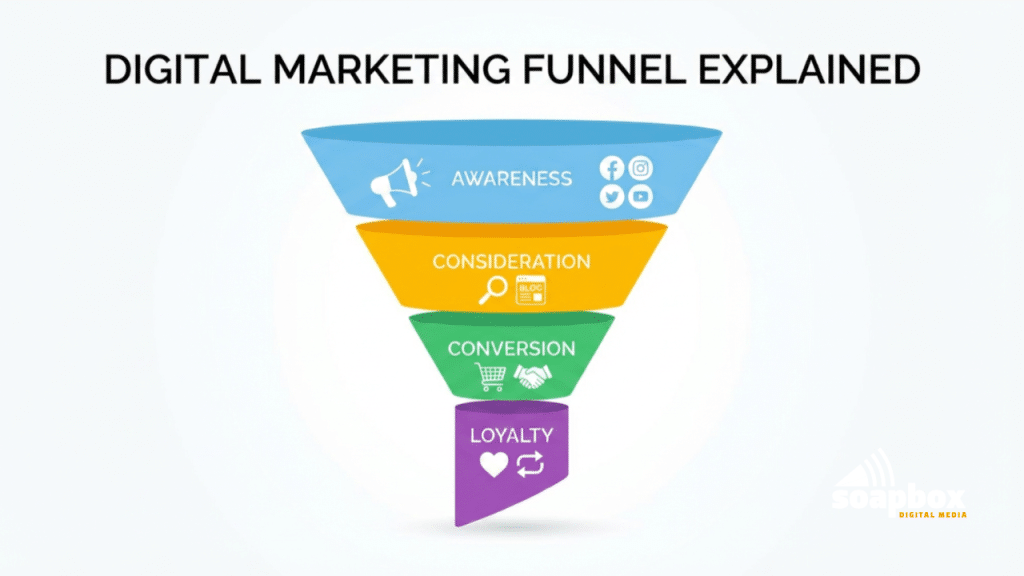
The funnel is a visual representation of how your audience narrows at each stage.
A thousand people might see your Facebook ad. Three hundred click through to your website. Fifty sign up for your email list. Ten request a quote. Three become customers.
That narrowing is normal.
The job of the funnel is to make each transition as smooth as possible so you lose fewer people at every stage of the marketing funnel.
The Key Stages of the Digital Marketing Funnel
Different marketers use different labels, but most digital marketing funnels break down into four stages: Awareness, Consideration, Conversion, and Loyalty.
You’ll also hear the shorthand TOFU (top of funnel), MOFU (middle of funnel), and BOFU (bottom of funnel), which map roughly to the first three.
Awareness (TOFU: Top of the Funnel)
At the top of the funnel, people are becoming aware of a problem they have or a product they want. They might not know your business exists yet.
The goal at this stage is to increase brand awareness and get in front of new audiences who match your target customer profile.
TOFU marketing strategies focus on attracting attention and reaching people who haven’t heard of you.
Blog posts, social media campaigns, YouTube videos, podcast appearances, Google Ads for broad keywords, and display advertising all work at this stage.
The content should be helpful and educational rather than salesy, because these people are aware of a problem but they’re not ready to buy a solution yet.
They’re researching, browsing, and comparing.
The metric that matters at TOFU is reach.
How many of the right people are seeing your marketing messages? If nobody knows you exist, nothing further down the funnel matters.
Consideration (MOFU: Middle of the Funnel)
In the middle of the funnel, potential customers know who you are and they’re evaluating whether you can help.
They’re comparing you with your competitors, reading reviews, looking at case studies, and trying to decide whether your product or service is the right fit.
MOFU marketing strategies focus on building trust and demonstrating value.
Webinars that go deeper on a topic, detailed guides that address specific pain points, comparison pages, and case studies that show real results.
This is where you nurture leads by giving them reasons to choose you over the alternatives.
The content at this stage should tailor its marketing messages to the questions and objections your potential customers have.
What does it cost? How does it work? Why should I trust you? How long does it take? MOFU content answers all of that directly, highlighting the benefits of your product or service at each step of the buying journey.
If you leave those questions unanswered, the customer will go to a competitor who doesn’t.
Conversion (BOFU: Bottom of the Funnel)
At the bottom of the funnel, the customer is ready to act.
They’ve done their research, they’ve narrowed their options, and they’re looking for a reason to commit. The goal at BOFU is to make the conversion as easy and risk-free as possible.
BOFU marketing strategies include:
- free trials
- consultations
- discount codes
- strong calls to action
- testimonials
- guarantee offers
- retargeting ads to follow up with people who’ve visited your website but haven’t converted
The content here is direct.
“Book your free consultation”, “Get 20% off your first order”, “Request your quote today”.
You’ve already built trust through the earlier funnel stages, so now it’s about removing the last barriers to action.
The metric at BOFU is conversion rate. Of all the people who reach this stage, how many actually take the action you want?
If people are getting to the bottom of your funnel but not converting, the problem is usually on the landing page, in the offer, or in the checkout process, not in the marketing that brought them there.

Loyalty and Advocacy (Post-Purchase)
The funnel doesn’t end at the sale.
Satisfied customers can become brand advocates who refer friends, leave reviews, and generate word-of-mouth traffic that feeds back into the top of the funnel.
Long-term relationships with existing customers are more profitable than constantly chasing new ones, because repeat customers spend more and cost less to convert.
Post-purchase marketing strategies include:
- loyalty programmes
- exclusive offers for returning customers
- personalised email marketing and marketing communications
- asking for reviews
The aim is to foster brand loyalty and help satisfied customers become brand advocates.
The goal is to keep customers engaged so they buy again and tell others about you.
Happy customers attract new customers without you having to spend on ads.
Digital Marketing Funnel vs Traditional Marketing Funnel
The traditional marketing funnel (sometimes called the AIDA model: Attention, Interest, Desire, Action) was built for a world where marketing was a one-way broadcast.
You ran a TV ad, placed a newspaper ad, or sent a direct mail piece, and then you waited.
There was no way to track whether someone saw your message, let alone where they dropped off.
The digital marketing funnel works differently because digital platforms give you data at every stage of the funnel.
You can see exactly how many people saw your ad, how many clicked, how many visited your website, how many signed up for your email list, and how many bought.
That visibility lets marketers identify where the funnel is leaking and fix the specific stage that’s underperforming, rather than guessing.
How Digital Marketing has Changed the Funnel
The other big difference is that the digital marketing funnel isn’t linear.
In a traditional marketing funnel, customers moved through the stages in order, often limited to a single store or geographic area.
In a digital funnel, people skip stages, jump back, revisit content they read weeks ago, and convert after touchpoints across multiple digital platforms and channels.
The rise of social media, retargeting, and marketing automation means the buyer’s journey is messy.
We like to view the funnel as a simplification that helps you make sense of the customer journey rather than a rigid path to purchase that every customer follows exactly.
Building an Effective Marketing Strategy Using The Funnel
Map Current Content to Funnel Stages
Audit what you already have.
Do you have blog posts and social media content that drives awareness (TOFU)? Guides, case studies, and email sequences that build trust (MOFU)? Clear landing pages with strong calls to action that drive conversion (BOFU)?
Most businesses are strong in one or two stages and weak in others.
Identify the gaps and fill them.
Choose Right Channels for Each Stage
Not every marketing channel works at every stage.
Social media marketing and SEO are strong at the top of the funnel (awareness). There is a lot of myths surrounding SEO, so let’s cut through the noise in our guide!
Email marketing and retargeting are strong in the middle (consideration).
Paid search targeting high-intent keywords, landing pages, and relevant ads are strong at the bottom (conversion).
The marketing funnel allows you to allocate budget (and time) to the channels that match each stage rather than spreading it evenly across everything.
Set Metrics for Each Stage
Know what success looks like at every stage of the funnel.
For newer businesses, that might mean prioritising awareness above everything else. For established ones, the focus often shifts to consideration and conversion.
A general guide to metrics for each stage include:
- TOFU: impressions, reach, website traffic
- MOFU: email signups, content downloads, time on site
- BOFU: conversion rate, cost per lead, return on investment
Track these KPIs consistently.
You’ll see where your funnel is strong and where customers at different stages are dropping off.
Optimise the Transitions
The biggest gains usually come from improving the transitions between stages rather than pouring more people into the top.
If your website gets plenty of traffic but nobody signs up for your email list, the TOFU-to-MOFU transition is broken.
If people open your emails but never click through to your offer, the MOFU-to-BOFU transition needs work.
Focus on the weakest link in the chain and you’ll see the biggest improvement in overall results.
Why Marketing Funnels Are Important
Without a funnel framework, marketing efforts tend to be scattered.
You post on social media because you feel you should. You run ads but don’t know if they’re working. You get website traffic but no enquiries.
Marketing funnels are important because they give structure to how you attract new customers, guide customers through the buying decisions process, and retain them afterwards.
A well-built funnel ensures that your marketing process covers every stage of the buyer’s journey.
For most small businesses, the biggest immediate win from thinking in funnel terms is realising that traffic alone doesn’t generate revenue.
A hundred website visitors who leave without taking action are worth less than ten visitors who enter an effective marketing funnel and come out the other end as customers.
Need Help Building Your Funnel? Contact Soapbox Digital Media Today
Here are Soapbox Digital Media, we do digital marketing every day.
We are professionals at uncovering hidden problems in your business marketing funnel and strategising marketing plans to help your business grow. If you have a business in Glasgow or across the UK, we are happy to help build content marketing and SEO plans.
For seamless strategies, call us on 0141 429 1356 or get in touch through our website. We’ll take a look at where your funnel is leaking and show you how to fix it.