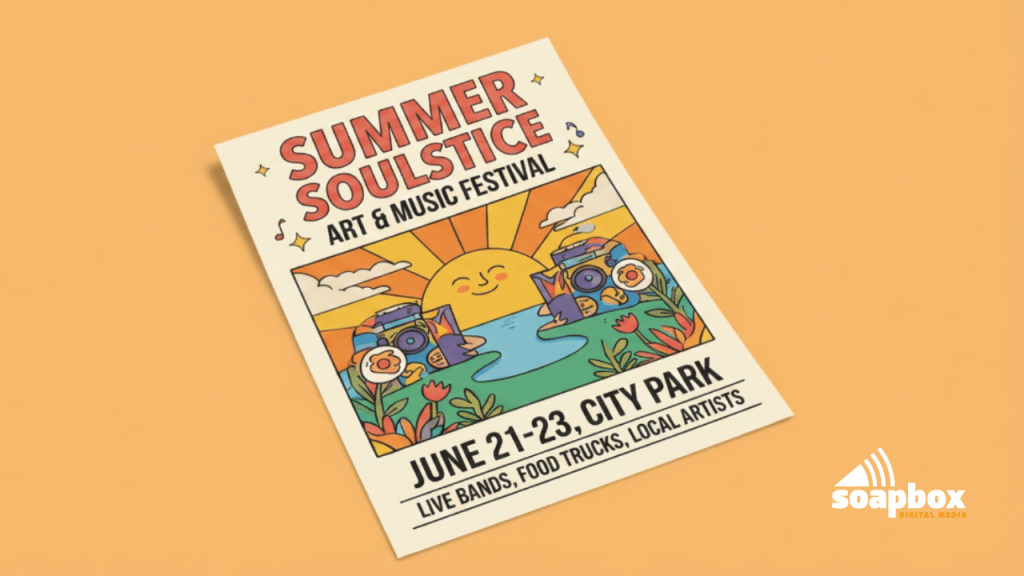
A flyer is a single sheet of paper printed with a promotional or informational message. They are designed for wide distribution and typically posted in public places or handed out to individuals.
Flyers have been around since the arrival of the printing press in the 15th century. This was when printed sheets were used to spread political messages and announce events.
So exactly what is a flyer in modern marketing, and why are they still being printed in 2026 when social media can reach the same audience?
We design and print flyers for clients across Glasgow and the wider UK. We will walk you through everything you need to know about flyers and how they can help your business, event, or mission.
What is a flyer? – By printing professionals in Glasgow
The meaning of flyer in print and marketing is straightforward.
It is a form of paper advertisement intended for wide distribution, usually printed on a single sheet of paper and used to promote a business, event, product, or cause.
Flyers are typically printed on A4 or A5 paper, sometimes printed on both sides to fit more information.
They can be printed on various paper stocks (gloss, silk, uncoated) and distributed in a public place, through direct mail, or handed out in person by a flyer team. The campaign depends on the audience and the message.
The word flyer has been used since the late 19th century, evolving from “fly sheet” to describe any small printed handbill.
Today, the term covers both printed flyers and digital flyers, which are the same concept produced for email, web, and social media platforms instead of paper.
What is the purpose of a flyer?
The purpose of a flyer is to get a simple, specific message in front of as many people as possible in your target audience.
Flyers are used to announce openings, promote events, advertise sales and discounts, raise awareness for causes, and prompt potential customers to take the next step. Whether that’s visiting a website, calling a phone number, or turning up at a specific time and place.
A flyer is typically posted or distributed in places where the target audience already spends time.
Student union boards for a freshers’ event, gym noticeboards for a fitness class, cafe windows for a local gig, and industry bulletin boards for a trade service.
If you are using flyers to promote your business, they tend to work best when the distribution matches where your potential customers actually are. Not where’s convenient to drop a stack.
The main types of flyers
Types of flyers vary by purpose, but most fall into a handful of categories that cover the vast majority of flyer production.
Promotional flyers
A promotional flyer pushes a specific offer.
A discount, a limited-time deal, a coupon, or a launch.
Promotional flyers need a bold headline, a clear call to action, and a deadline or reason to act fast.
Retailers, restaurants, and services use promotional flyers as promotional materials to entice new customers and drive foot traffic, for local levels, it can be highly effective.

Informational flyers
Informational flyers carry important information rather than a sales pitch.
It may be community announcements, safety notices, charity information, or health advice.
Informational flyers tend to be text-heavier than promotional ones and focus on getting the necessary information across clearly.
Event flyers
Event flyers promote a specific date and location.
Gigs, festivals, club nights, open days, conferences, and fundraisers all use event flyers.
A good event flyer front-loads the event details, from the name, date, time, venue, and price.
The design of your flyer for an event usually leans on strong imagery and typography to match the mood of the event itself.
Business flyers
A business flyer introduces a company, service, or product to potential customers.
Business flyers are used for new business launches, service updates, and to build brand awareness in a local area.
Tradespeople who distribute flyers through letterboxes in a target postcode find that a well-timed drop is still one of the most effective forms of local marketing for plumbers, gardeners, window cleaners, and similar services.
Club flyers
A club flyer promotes a nightclub, DJ set, or music event.
Club flyers tend to be visually striking, smaller flyers (often A6 or DL size) designed to be handed out at related venues, and heavily branded with artist names and artwork that matches the night.
Digital flyers
Digital flyers are the same design philosophy delivered through online distribution.
This might be via an email campaign, social media platforms, WhatsApp groups, or community Facebook pages.
Digital flyers cost nothing to send once designed, reach audiences instantly, and can link directly to booking pages, email addresses, or websites.
Most flyer campaigns now run a combined approach with physical flyers for local distribution and digital flyers for wider reach.
The elements of a good flyer
The elements of a flyer are fairly consistent across different flyer formats. A well-designed flyer does the following well:
- An attention-grabbing headline that makes someone pause for longer than they would otherwise.
- A clear visual focal point. Perhaps an image, an illustration, or a strong piece of typography.
- A short block of flyer copy covering what, when, where, why.
- A specific call to action telling the reader what to do next (phone, scan, visit, book).
- Contact details: phone, email, website, or a QR code linking to your booking page.
- Branding (logo, colours, and style) consistent with your wider business identity.
- Plenty of white space so the flyer doesn’t feel cluttered.
Flyers may include images, icons, coupons, vouchers, or loyalty program offers, but the core structure stays the same.
If any of those elements is missing, the flyer probably isn’t doing its job. A flyer without a clear call to action is just a decoration.
What is a good size for a flyer?
Flyer size in the UK usually comes down to four standard paper sizes:
A4 (210 x 297 mm)
The largest common flyer size.
Good for events, service flyers, and anywhere you need space for detail. Used for doorstep drops and wall posters.
A5 (148 x 210 mm)
The most common flyer size in UK print marketing.
Half the size of A4, easier to hand out, cheaper to print in volume.
A6 (105 x 148 mm)
Postcard-sized, perfect for club flyers, vouchers, and smaller flyers that need to fit in a wallet or pocket.
DL (99 x 210 mm)
The classic long-thin flyer size that fits a standard envelope and looks upmarket on a tradeshow stand.
Benefits of choosing correctly
Smaller flyers are cheaper per unit and easier to distribute, though they carry less information.
Larger formats give you more room for design, but cost more per print and are harder to hand out on a busy street.
Picking the right flyer size is usually the first design decision to make.
Flyer vs brochure vs pamphlet vs poster
A flyer, a brochure, a pamphlet, and a poster all sit in the same family of printed marketing, but they differ by format and purpose.
Brochure
A brochure is a folded sheet of high-quality paper with multiple panels, usually tri-fold or bi-fold, used to give a more detailed description of a product, service, or company.
Brochures carry more content than flyers and are usually kept longer by the reader. A brochure is a folded sheet with panels; a flyer is a single unfolded sheet.
Pamphlet
A pamphlet sits somewhere between a flyer and a brochure.
Pamphlets are usually folded and carry a longer informational message, often on a single topic, and are more commonly used for educational or advocacy purposes than commercial marketing.
Poster
A poster is a larger printed advertisement (A3 and upwards) designed to be displayed on a wall or hoarding and viewed from a distance.
Posters carry less text than flyers because they’re read at a glance, and they stay in place rather than being handed out.
The benefits of flyers for your business
The benefits of flyers are why they’ve stayed a core tool in print marketing despite every prediction that digital would kill them off.
Flyers are inexpensive
Flyers are inexpensive to print and cheap to distribute.
This makes flyers one of the most cost-effective ways to reach a wide audience. Compare that to the cost of a paid social campaign reaching the same number of locally relevant eyes.
Flyers are physical
A physical flyer stays with the reader.
It lives on the fridge, in a pocket, on a kitchen counter, or pinned up on a noticeboard. Digital ads vanish from a feed within seconds.
Flyers are often seen several times before the reader takes action. Repeat exposure through flyers tends to outperform one-off digital impressions in local marketing.
Flyers target specific areas
Flyers let you target specific streets, estates, or neighbourhoods with precision that online targeting can’t always match.
Dropping flyers through letterboxes in a three-street radius of a new gym catches exactly the audience most likely to sign up, without the waste of advertising to people who live miles away.
Flyers work alongside digital
A QR code on a flyer hands the reader straight into your digital marketing funnel.
Print and digital work better together than either alone.
A flyer is also an effective form of brand awareness, reinforcing your branding every time someone sees it.
How to design a flyer properly
Designing a flyer from scratch comes down to three decisions.
What one thing you want the reader to do, what one thing you want them to remember, and what one visual will stop them long enough to read the rest.
A professionally designed flyer keeps those three things front and centre.
You can design a flyer yourself using an online flyer maker like Canva, Adobe Express, or similar marketing tools.
These have hundreds of pre-built flyer templates you can adapt, swap photos into, and tweak to match your brand.
Choose a template that suits the type of flyer you’re producing, edit the copy to your specific message, and download a print-ready PDF with crop marks and bleed for the printer.
For a professional result, many businesses work with a graphic design team to design a custom flyer matched to their existing branding.
Custom flyer design costs more upfront than templates but produces artwork that’s unique, on-brand, and designed specifically for your audience.
Make sure your flyer gets the same level of design attention as your website or logo, because it’s one of the first impressions potential customers have of your business.
Ready to design and print a flyer for your business?
Using flyers to promote your business is still one of the fastest, cheapest ways to reach a local audience with a clear message.
At Soapbox Digital Media, we handle flyer design and print for businesses across Glasgow and the wider UK, from single-batch promotional flyers to ongoing flyer campaigns that plug into wider marketing strategies.
Whether you need our graphic designers to help create a flyer from scratch or print artwork you’ve already created, we’ve got you covered! We’ll make sure the flyer is professionally designed, printed on quality stock, and ready to reach your audience. Or if you need something else printed, posters, wedding invitations, or more, we’ve got you covered for that too.
Give our friendly team a call on 0141 429 1356 or drop us a note through our contact page to talk through your flyer brief.